
Matching Personality Styles (A, R, C, U) to Job Requirements
Organizations are most effective when employees’ personalities align with the requirements of their roles. Different jobs demand different ways of thinking, interacting, and solving problems. One useful framework for understanding these differences divides personality into four styles or dimensions: accomplishing, regulating, creating, and uniting. Each style reflects a distinct set of motivations, strengths, and work preferences. Matching job requirements with these personality styles helps organizations improve productivity, employee satisfaction, and overall performance.
The accomplishing personality style (A) focuses on achieving goals, completing tasks, and delivering results efficiently. Individuals with this style are typically driven, competitive, and action-oriented. They prefer clear objectives and enjoy working in environments where performance and outcomes are emphasized. Jobs that require decision-making, leadership, and measurable results are well suited for this personality type. For example, roles such as project managers, sales representatives, entrepreneurs, and operations managers often require the ability to set targets, overcome obstacles, and push projects forward. When individuals with an accomplishing style are placed in these roles, they tend to thrive because the job aligns with their natural drive for achievement and success.
The regulating personality style (R) emphasizes structure, organization, and attention to detail. People with this style value rules, procedures, and consistency. They are often careful planners who prefer predictable environments where tasks are clearly defined. Jobs that require precision, reliability, and systematic processes are well suited for regulating personalities. Positions such as accountants, quality assurance specialists, administrative coordinators, and compliance officers rely heavily on these strengths. In these roles, employees must follow established guidelines, maintain accurate records, and ensure that standards are met. Matching regulating personalities with these jobs helps organizations maintain stability, accuracy, and efficiency.
The creating personality style (C) is associated with innovation, imagination, and strategic thinking. Individuals with this style enjoy exploring new ideas, experimenting with possibilities, and solving complex problems in unique ways. They are typically comfortable with change and uncertainty, and they often prefer flexible environments where creativity is encouraged. Jobs in fields such as marketing, design, research and development, product development, and entrepreneurship often require a creating personality style. In these roles, employees must generate original ideas, envision new opportunities, and adapt quickly to evolving challenges. When creating personalities are given the freedom to innovate, they can contribute significantly to organizational growth and competitive advantage.
The uniting personality style (U) focuses on relationships, collaboration, and teamwork. People with this style are empathetic, supportive, and skilled at building connections with others. They value harmony in the workplace and often act as mediators or facilitators in group settings. Jobs that involve communication, teamwork, and helping others benefit greatly from uniting personalities. Roles such as human resources specialists, teachers, counselors, customer service representatives, and team leaders often require strong interpersonal skills and emotional intelligence. In these positions, individuals must listen carefully, resolve conflicts, and motivate others to work together toward shared goals.
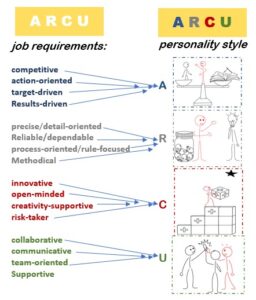
Matching job requirements with these personality styles is beneficial for both employees and organizations. When individuals work in roles that fit their natural tendencies, they are more likely to feel engaged, confident, and satisfied with their work. At the same time, organizations benefit from higher productivity, better teamwork, and improved performance. However, it is also important to recognize that most people exhibit a combination of these styles rather than only one. Successful teams often include a balance of accomplishing, regulating, creating, and uniting personalities, allowing them to handle a wide range of tasks and challenges.
In conclusion, understanding the four personality styles – accomplishing, regulating, creating, and uniting – can help organizations match employees with roles that suit their strengths. Accomplishing personalities excel in goal-driven positions, regulating personalities thrive in structured environments, creating personalities contribute through innovation, and uniting personalities strengthen teamwork and relationships. By aligning job requirements with these personality dimensions, organizations can build more effective teams and create workplaces where employees can perform at their best.
Vesna ZL
Leave a Reply